

If you’ve ever noticed ringing, buzzing, humming, hissing, or another sound in your ears that no one else seems to hear, you may be experiencing tinnitus. For some people, tinnitus appears briefly and disappears. For others, it comes and goes, changes in intensity, or becomes a persistent part of everyday life.
That can lead to an important—and sometimes difficult—question: Is tinnitus temporary or permanent?
There isn’t one answer that applies to everyone. Tinnitus is a symptom rather than a single condition, and how long it lasts often depends on what’s contributing to it. Some causes may result in temporary tinnitus that improves when the underlying issue resolves. Other forms of tinnitus are associated with permanent changes to the auditory system and may become chronic.
Even persistent tinnitus can fluctuate, however. It may seem louder one day and quieter the next, or become more noticeable under certain circumstances.
Understanding these differences can help you recognize when it’s time to have your hearing and tinnitus professionally evaluated.
What Is the Difference Between Temporary and Permanent Tinnitus?
Temporary tinnitus lasts for a limited period of time and eventually resolves. Depending on the circumstances, it could last minutes or hours, or potentially longer while an underlying temporary condition persists.
Persistent or chronic tinnitus continues over time. In some cases, it may be associated with permanent damage or changes within the auditory system, including hearing loss.
Then there’s fluctuating or intermittent tinnitus. The sound may come and go, or tinnitus may always be present but change noticeably in volume or intensity.
These categories aren’t necessarily as clear-cut as they sound. The same general trigger can potentially produce temporary symptoms in one situation and contribute to lasting damage in another.
That’s one reason you shouldn’t assume tinnitus is temporary—or permanent—based solely on how it sounds.
What Can Cause Temporary Tinnitus?
Temporary tinnitus can occur when something temporarily affects the ear or auditory system. Once the underlying problem resolves, the tinnitus may improve or disappear.
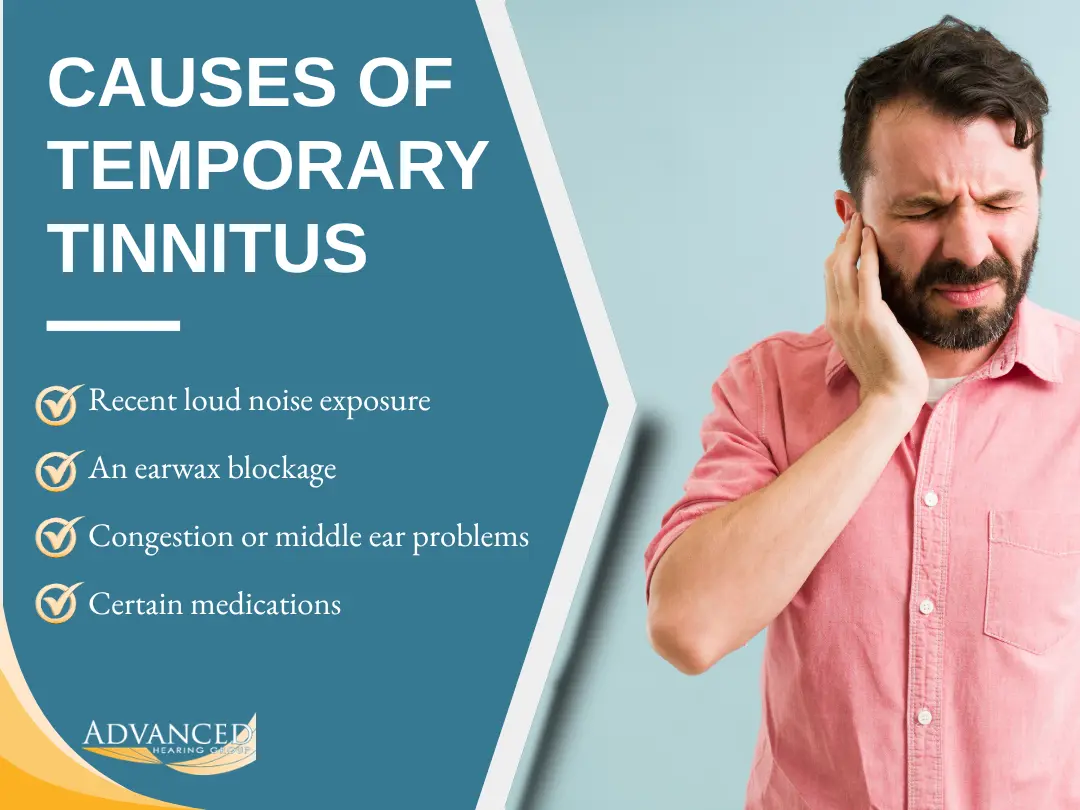
Some potential contributors include:
1. Recent Exposure to Loud Noise
Have you ever left a concert, sporting event, nightclub, or other loud environment and noticed your ears ringing afterward?
Noise exposure can temporarily change hearing sensitivity and cause tinnitus. The ringing may gradually subside as your auditory system recovers.
However, ringing after loud noise should not be considered harmless simply because it eventually disappears. Excessive noise can damage the delicate structures within the inner ear. Repeated or sufficiently intense exposure can result in permanent hearing damage.
In other words, tinnitus after loud noise can be a warning that your ears have been exposed to potentially damaging sound.
2. Earwax Blockage
Earwax plays an important role in protecting your ear canal, but excessive or impacted earwax can sometimes interfere with hearing and may be accompanied by tinnitus.
If earwax is contributing to the problem, symptoms may improve once the blockage is safely removed.
Avoid trying to remove impacted earwax yourself with cotton swabs or other objects. These can push wax farther into the ear canal or potentially injure the ear. A hearing healthcare professional can examine your ears and determine whether excessive earwax may be affecting your hearing.
3. Congestion or Middle Ear Problems
Changes involving the middle ear can temporarily affect the way sound is transmitted.
For example, congestion, pressure changes, middle-ear fluid, or problems involving the Eustachian tube may alter hearing and sometimes occur alongside tinnitus or a feeling of fullness in the ear.
If tinnitus appears during an illness or period of significant congestion, it may improve as the underlying problem resolves. Persistent symptoms should still be evaluated.
4. Certain Medications
Some medications are associated with tinnitus or other changes in hearing. These are sometimes described as ototoxic effects.
Whether symptoms are temporary or permanent depends on several factors, including the particular medication, dosage, duration of treatment and individual response.
Never stop or change a prescribed medication because you develop tinnitus without first speaking with the healthcare professional who prescribed it. If you notice tinnitus or a change in hearing after starting or changing a medication, tell your physician and audiologist.
What Can Cause Permanent or Chronic Tinnitus?
Tinnitus is more likely to persist when it’s associated with lasting changes within the auditory system.
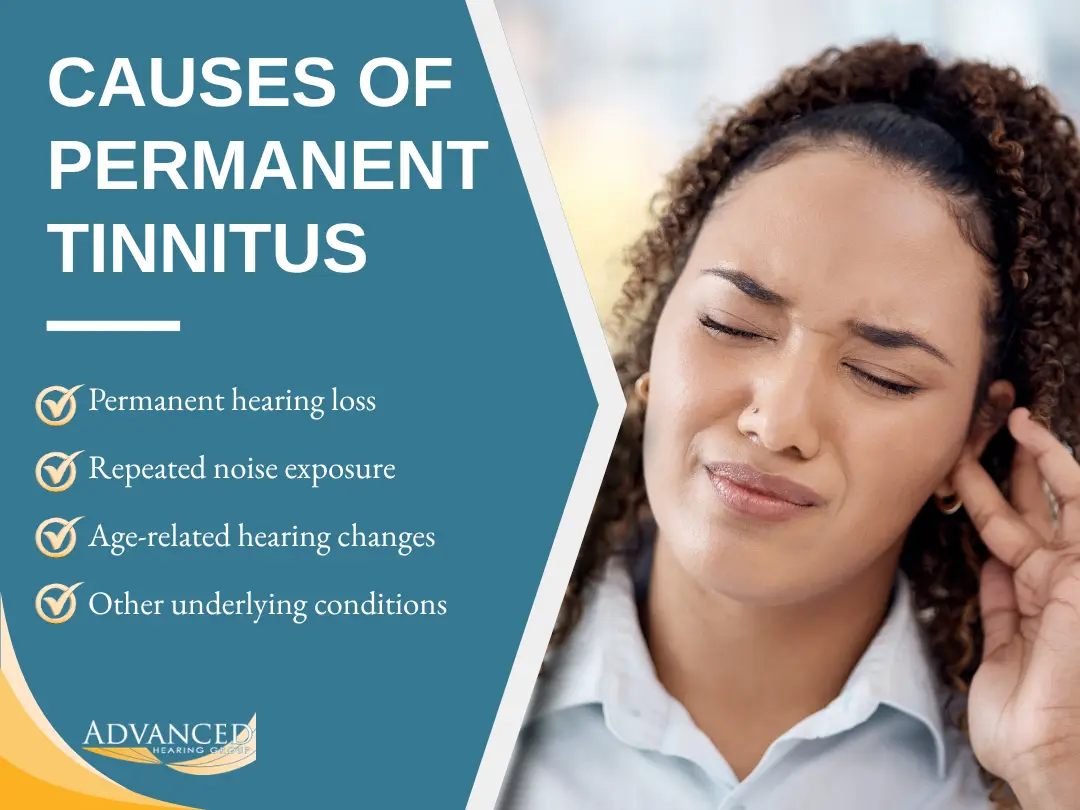
1. Permanent Hearing Loss
Tinnitus and hearing loss frequently occur together.
The inner ear contains delicate sensory hair cells that help convert sound vibrations into signals the brain can interpret. Damage to these structures can result in permanent sensorineural hearing loss because these hair cells do not regenerate.
When tinnitus accompanies permanent hearing loss, the tinnitus itself may also persist.
Importantly, you can have hearing loss without realizing it. Hearing loss often develops gradually, and the first symptom that gets someone’s attention may actually be tinnitus rather than obvious difficulty hearing.
2. Long-Term or Repeated Noise Exposure
Noise-induced hearing loss doesn’t only happen after one extremely loud event. It can develop gradually after years of exposure to loud machinery, power tools, firearms, music, recreational activities, or occupational noise.
Repeated exposure can permanently damage structures in the inner ear.
This illustrates why the distinction between temporary and permanent tinnitus isn’t always simple. One loud event might produce temporary ringing that disappears, while repeated exposure over time can contribute to permanent hearing loss and chronic tinnitus.
If you’re regularly around loud sound, appropriate hearing protection can help reduce your risk of noise-induced hearing damage.
3. Age-Related Changes in Hearing
Hearing commonly changes as we get older, and age-related hearing loss may be accompanied by tinnitus.
Because age-related hearing loss generally develops gradually, tinnitus may also seem to appear slowly or become increasingly noticeable over time.
A comprehensive hearing evaluation can help determine whether hearing loss is present, even if you haven’t noticed significant difficulty hearing conversations.
4. Other Underlying Conditions
Tinnitus can have many possible contributors beyond hearing loss, including certain ear disorders, head or neck injuries, medications and other medical conditions.
This is why determining whether tinnitus is likely to be temporary or persistent starts with identifying as much as possible about what may be contributing to it.
Why Does My Tinnitus Come and Go?
Not everyone experiences tinnitus continuously.
Some people have intermittent tinnitus, meaning the sound appears and disappears. Others have tinnitus most or all of the time but notice significant changes in how loud or intrusive it seems.
Fluctuating tinnitus doesn’t necessarily mean the underlying condition itself is appearing and disappearing.
Your awareness of tinnitus can change depending on what’s happening around you and within your body.
For example, tinnitus may seem more noticeable:
- In a very quiet room
- At bedtime
- During or following periods of stress
- When you’re tired or haven’t slept well
- Following exposure to loud sound
- When another ear or hearing problem is affecting your hearing
If the auditory input reaching your brain changes, your perception of tinnitus may change along with it.
The pattern itself can provide useful information to your audiologist. If your tinnitus fluctuates, pay attention to when it occurs, how long it lasts, whether it affects one or both ears, and whether you notice changes in hearing at the same time.
Why Is My Tinnitus Louder Some Days?
People with persistent tinnitus often describe “good days” and “bad days.”
That doesn’t necessarily mean additional damage is occurring every time tinnitus becomes more noticeable.
Tinnitus perception can be influenced by your surroundings, attention, stress, sleep and other factors. A sound that barely registers while you’re busy in a noisy environment might seem dramatically louder when you’re lying in a silent bedroom.
This relationship between tinnitus and attention can also create a frustrating cycle. The more intrusive tinnitus seems, the more attention you may give it—and the more difficult it may become to ignore.
Changes in tinnitus shouldn’t automatically be dismissed, though. A significant or sudden change, especially when accompanied by changes in hearing or other symptoms, deserves professional attention.
How Can You Tell if Tinnitus Is Temporary or Permanent?
Unfortunately, there isn’t a simple test you can perform at home to determine whether tinnitus will disappear.
An audiologist can gather much more useful information by looking at the tinnitus in the context of your overall hearing health.
Your evaluation may include questions about:
- When the tinnitus started
- Whether it began suddenly or gradually
- Whether it’s constant or intermittent
- How the tinnitus sounds
- Whether it’s in one ear or both
- Recent or long-term noise exposure
- Changes in hearing
- Ear pressure, fullness, pain, or other symptoms
- Current medications
- Your medical and hearing history
A comprehensive hearing evaluation can then help identify hearing loss or other changes that may be associated with your tinnitus.
Depending on your symptoms and test results, your audiologist may also recommend evaluation by an ENT or another healthcare provider.
The goal isn’t simply to label your tinnitus as “temporary” or “permanent.” It’s to better understand why you’re experiencing it and what can be done about it.
Does Tinnitus Mean I Have Permanent Hearing Loss?
No. Experiencing tinnitus doesn’t automatically mean you have permanent hearing loss.
Tinnitus can occur for many reasons, including temporary conditions. At the same time, tinnitus is commonly associated with hearing loss, and you may have changes in hearing that aren’t immediately obvious in everyday life.
That’s why tinnitus is a good reason to have your hearing professionally evaluated rather than assuming everything is fine because you can still hear.
A hearing test can provide objective information about your hearing sensitivity and help your audiologist determine whether hearing loss could be contributing to your tinnitus.
Can Permanent Tinnitus Be Treated?
The word “permanent” can sound like “untreatable,” but those aren’t the same thing.
Even when the underlying changes associated with tinnitus cannot be reversed, there may be ways to make tinnitus less noticeable or disruptive.
Tinnitus management depends on the individual and what is contributing to the symptoms.
For people who also have hearing loss, appropriately fitted hearing aids may help by improving access to external sounds. Increasing meaningful auditory input can make tinnitus less prominent for some people.
Learn more: Hearing Aids and Tinnitus: How the Right Treatment Can Help You Find Relief
Other approaches may include sound therapy, tinnitus education and counseling, strategies for reducing the impact tinnitus has on everyday activities, and management of contributing hearing or medical conditions when possible.
The appropriate approach begins with an individualized evaluation.
When Should You See an Audiologist for Tinnitus?
If you’ve experienced a few seconds of ringing that disappears and never returns, it may not require further attention.
But tinnitus should be professionally evaluated when it:
- Persists or repeatedly returns
- Becomes more frequent or noticeable
- Interferes with sleep, concentration, work, or everyday activities
- Occurs alongside suspected hearing loss
- Changes significantly from your usual tinnitus
- Causes concern or affects your quality of life
Certain tinnitus symptoms may also require medical evaluation. Seek prompt professional guidance for tinnitus that begins suddenly, particularly when it occurs with sudden hearing loss. Tinnitus affecting only one ear, pulsatile tinnitus that seems synchronized with your heartbeat, or tinnitus accompanied by significant dizziness, neurological symptoms, ear pain, or drainage should also be appropriately evaluated.
An audiologist can help determine what your hearing tests show and whether referral to an ENT or another medical professional is appropriate.
Learn more: ENT or Audiologist for Tinnitus: Who Should You See First?
FAQs About Temporary and Permanent Tinnitus
How long does temporary tinnitus last?
There isn’t a universal timeframe. Temporary tinnitus may last minutes or hours in some situations, while tinnitus associated with an underlying temporary ear problem may continue until that problem resolves. Tinnitus that persists, repeatedly returns, or concerns you should be professionally evaluated.
Does tinnitus always become permanent?
No. Some episodes of tinnitus are temporary. Whether tinnitus persists depends partly on what’s causing or contributing to it.
Why does my tinnitus come and go?
Tinnitus can fluctuate for many reasons. Changes in surrounding sound, stress, sleep, noise exposure, hearing, or an underlying ear condition can potentially affect how noticeable tinnitus seems. If you’re experiencing recurrent tinnitus, an evaluation can help look for possible contributing factors.
Can earwax cause temporary tinnitus?
Excessive or impacted earwax can affect hearing and may be associated with tinnitus. When earwax is responsible, symptoms may improve after the blockage is safely removed.
Can loud noise cause permanent tinnitus?
Yes. Excessive noise exposure can permanently damage the auditory system and is an important preventable cause of hearing loss. Tinnitus following noise exposure may be temporary, but repeated or sufficiently intense exposure can contribute to lasting hearing damage.
Does tinnitus mean my hearing is getting worse?
Not necessarily. Changes in tinnitus perception don’t automatically mean that additional hearing damage is occurring. However, because tinnitus and hearing loss often occur together, new or changing tinnitus is a good reason to have your hearing checked.
Can tinnitus go away even if I’ve had it for a long time?
Tinnitus experiences vary considerably. Some people’s tinnitus changes or becomes less noticeable over time, while others continue to experience it. Even when tinnitus persists, management strategies may help reduce how much it affects daily life.
Should I have a hearing test if I have tinnitus but think my hearing is normal?
Yes, particularly if your tinnitus is persistent or recurrent. Hearing changes aren’t always obvious, and a comprehensive hearing evaluation can identify hearing loss you may not have noticed.
Don’t Guess About What’s Causing Your Tinnitus
When tinnitus first appears, it’s natural to wonder, “Will this go away?”
Sometimes it does. Sometimes it persists. And sometimes tinnitus changes from day to day.
What matters most is understanding that tinnitus can have many possible contributors, and the duration or loudness of the sound alone usually can’t tell you what’s causing it.
At Advanced Hearing Group, our audiologists can evaluate your hearing and tinnitus, look for hearing-related factors that may be contributing to your symptoms, and discuss appropriate next steps. When additional medical evaluation is warranted, we can also help determine when another healthcare specialist should become part of your care.
If you’re experiencing persistent, recurring, or changing tinnitus, schedule an appointment with our audiologists in Mesa or Scottsdale, Arizona. A professional tinnitus and hearing evaluation can help you better understand what you’re experiencing and what options may be available to help.