

Infant hearing loss is not something any parent wants to face. Newborn babies are a miracle. How they start out as a tiny bundle of cells and turn into a gurgling bundle of joy is a topic that scientists have studied for generations. It’s also amazing how they are born with miniature parts that function perfectly, at least most of the time. Occasionally, however, babies are born with defects and they end up with health problems like infant hearing loss.
Fortunately, the medical field has come a long way in providing ways to screen for health problems at birth. For example, most newborns get an infant hearing test before they even leave the hospital. Hearing loss, and other health problems, are not always immediately apparent, however, so it’s important to know the signs and symptoms that something is amiss.
How to recognize infant hearing loss
New parents are often baffled by what a baby needs. When he cries, is he hungry? Or, is he cold? Did he get startled by a loud noise? It takes some time to learn what your baby’s coos and cries mean. It can also take a while to know if your infant is completely healthy.
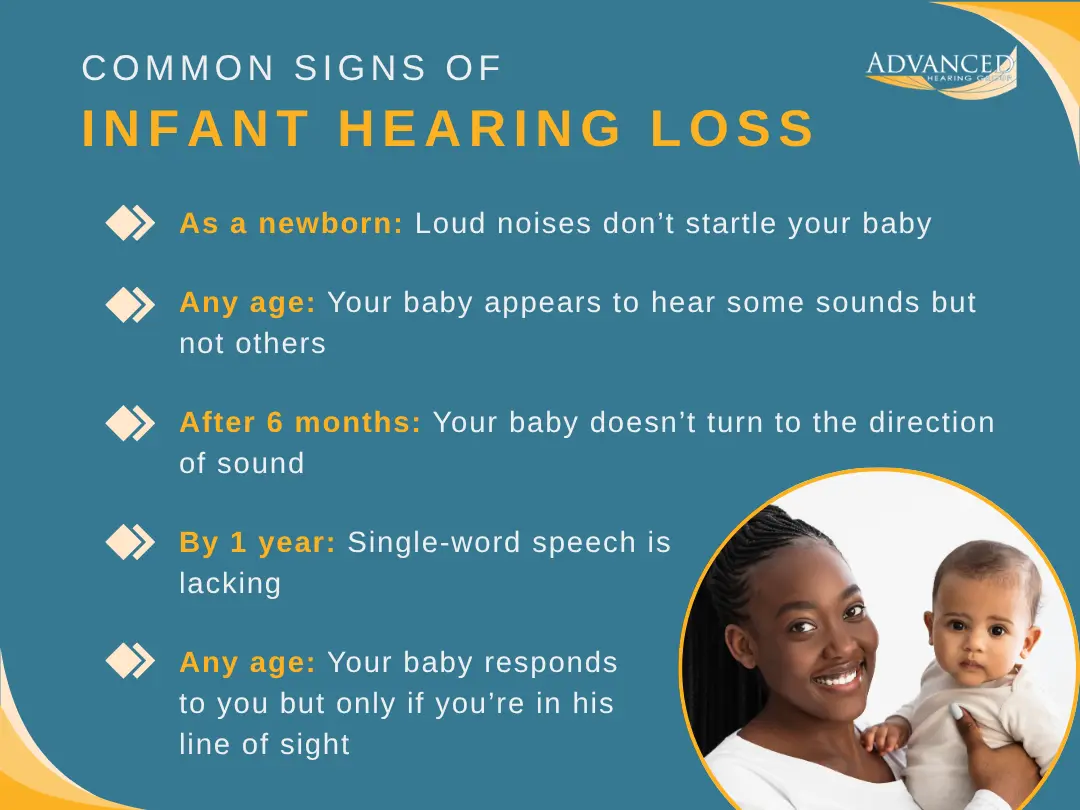
Here are 5 signs that your baby might have hearing loss:
- As a newborn: loud noises don’t startle your baby. You might think he’s just a great sleeper, but if this happens frequently, your baby may have a hearing problem.
- Any time: your baby appears to hear some sounds, but not others. If your baby reacts to a man’s voice, but not a woman’s, or if he startles at the dog barking but has no response to normal conversation, he could have hearing loss. Just like in adults, infant hearing loss can manifest as the inability to hear higher-pitched or softer sounds.
- After 6 months: your baby doesn’t turn in the direction of sound. A child with healthy hearing will usually turn his head toward sound. Seeing what is causing the sound is one way that babies begin to learn about and interpret their environment.
- By 1 year old: single-word speech is lacking. Babies use their hearing to pick up language cues and clues. Within the first year of life, most babies begin to speak at least single words, like “mama” or “dada.” With hearing loss, however, speech and language may be delayed.
- Any time: Your baby responds to you, but only if you’re in his line of sight. A baby with hearing loss may not respond to you calling him by name from behind.
Common treatments for infant hearing loss
The earlier that hearing loss in infants is diagnosed and treated, the better. As already mentioned, speech and language can be seriously delayed if hearing loss goes unnoticed. So, what are some treatment options? Ultimately, it depends on the type and cause of hearing loss, but some of the most common include:
- Cochlear implant – This device is typically used for infants with severe to profound hearing loss. It involves surgical implantation of one part of the device inside the ear, with
another part attaching to the outside of the head. - Ear tubes – These are intended to prevent fluid buildup inside the ear which could ultimately cause an ear infection and hearing loss.
- Hearing aids – These devices can be used in infants 1 month of age or older. Hearing aids will amplify sound, so they are most useful in babies that only have mild to moderate hearing loss.
If you suspect that your baby has a hearing impairment, schedule an appointment with his pediatrician or an audiologist as soon as possible. It is better to have him get a thorough hearing evaluation and know for sure, than to let it go untreated and lead to possible developmental delays.
Now, if only these babies came with a manual!
The post 5 Simple Ways to Recognize Infant Hearing Loss appeared first on Hear Well – Live Well.
Source: Hear Well-Live Well Blog